
MODULE 2
The Power of your Voice
Objectives
How your voice works
Using your voice is a physical activity. We breathe in (or inhale) through the nose. As we breathe out (or exhale), through the mouth, the air passes through the voice box (or larynx) and through the vocal chords (or vocal folds). The vocal chords vibrate as the air passes through them. This is where voice is created. These vibrations are then amplified and given tone in the resonating chambers: the throat (or pharynx), the nasal cavity and the mouth. Finally, the voice is ‘carved’ into speech by the organs of articulation, the jaw, lips, tongue, teeth, alveolar ridge and hard and soft palates.
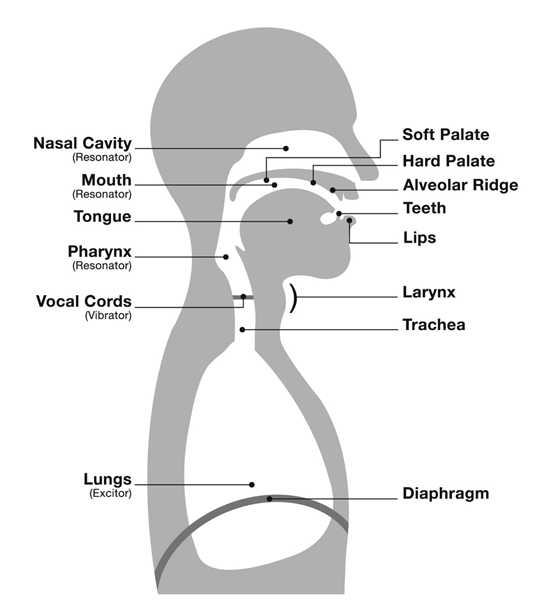
Using your Voice Effectively
What we say depends on how we say it. Without using the possibilities and potential of the sound of your voice, you would be limiting the communication of your message substantially. For your audience to access what you’re saying, meaning needs to be made by the way you say it. You can support your intended messages by how you use your voice. Help your audience understand and engage with what you are communicating by using your voice effectively. With the HOW you can qualify (and communicate) the WHAT. The voice is an expressive and powerful instrument and in order to use it as such, you need to understand how it works, how you can control it and what you can do to harness its power. Then you need to teach the muscles involved what they need to do to achieve your desired results.
Pause
Pause is the moment of silence between speaking. We use pause to divide our sentences up into thoughts/clauses/phrases and for emphasis. Using pause allows us to think ahead, to allow the audience to digest what we have just said and to take in a breath to support the voice. Music wouldn’t exist without the silences in between. The same way that pause gives meaning to music, it makes sense of what we say.
Phrasing
Phrasing refers to the separation of different thoughts within a sentence using pause to divide them. We pause where it makes sense to pause based on the meaning of what we’re saying or of what we want to say. These thoughts are not necessarily separated by punctuation. By using phrasing, we are better able to stay in control of what we’re saying as it allows us to build on what we have just said in a manner that is logical and easy to follow. Combining pause and phrasing enables you to stay in control and allows your audience to stay with you.
By phrasing and pausing where it makes sense to pause between thoughts, we break up our sentences into bite-sized chunks, allowing our audience to process one thought at a time through visualising it and personalising it. Once the audience has had a moment to think about what you’ve just said, members of the audience will be ready to hear your next thought. Think of your audience eating an apple – one bite at a time, chewing and swallowing (processing) the first bite, before being ready for the next bite. The audience’s processing of the thought and anticipation of the next one not only helps your audience to follow what you are saying but also helps them to engage with you. Effective use of pause and phrasing can give more power, emphasis and impact to what you’re saying. Where we pause or how we phrase a sentence depends on the inherent meaning of the sentence, on our interpretation of the sentence and on which aspects, or even words, of the sentence we would like to emphasise.
Breath Support
It is during the pauses that we inhale to support the voice. We may take in larger or smaller breaths depending on the length of the phrase/clause/thought we are about to speak. The longer the phrase/clause/thought before the next pause (and our next opportunity to refuel with breath), the larger the breath we will need to support the voice.
Projection
Projection comprises volume and direction. By direction, we mean sending the voice forward as opposed to swallowing it. When we speak, we are literally sending sound waves through space and the sound waves will eventually reach our listeners’ eardrums.
For effective projection to be achieved, it is important to use breath support to project with ease and avoid vocal strain. Your diaphragm then becomes your volume control – more breath exhaled more quickly can result in more sound being created. This sound needs to be projected, which can be assisted by your visualising sending the sound forward towards its destination, be it near or far. It is also important to have enough space in the mouth (to allow for that final point of amplification) and to form the vowel sounds clearly in order to release the sound and achieve effective projection.
Pace
Typically, we think more quickly than we speak or listen. Therefore, it is important to ensure that your dominant pace is not too quick so that a) the audience can follow what you’re saying and b) you can use your voice as a dynamic instrument with which to engage the audience. However, pace needs to be dynamic and varied – we don’t want everything to be said at the same pace or we my run the risk of monotony, resulting in losing our audience. We want our dominant pace to be slow enough for our audience to follow what we are saying however, within that, our pace needs to be varied. Pace is a wonderful tool for emphasis – by slowing down on a word you can emphasise it (think of it as a vocal highlighter) to assist in getting your point across. Slowing down on key words and using pause and phrasing effectively (as well as breath support) breaks your momentum and helps you achieve a slower dominant pace. Because your voice and body are part of the same instrument, opening your mouth on the open vowel sounds and clearly articulating your words, as well as slowing down your gestures, can also assist in slowing down your pace of speech. It is easier to slow down your body than to slow down your speech, so if you find yourself racing ahead, slow down a gesture on a key word to break your momentum before you reach your next pause.
Articulation
Articulation refers to how crisply and clearly we ‘carve’ our voice into speech. The formation of our vowels and consonants needs to be precise, crisp and specific to make our words clear and distinguishable. If we don’t articulate our consonants clearly, it will be difficult for the audience to hear what we are saying.
Tone
The sound of the voice can communicate more than the words themselves. We use our tone of voice to qualify our meaning of the words we speak. Imagine a mother soothing her small child with her voice, telling him that everything will be alright. Now imagine a foreman on a building site furiously reprimanding an employee for doing something that was potentially very dangerous for other employees. The difference in the tone of voice in the 2 scenarios is vast. In each case, the tone of voice would clearly communicate the emotions of the speaker and would help the listener to better understand the intended meaning of the speaker. Strong emotions need not be involved, however. We can use our resonance to colour what we say – using lighter tones from our upper resonators to indicate optimism for example and heavier tones from our lower resonators to assist in communicating something that is to be taken seriously.
Modulation
Modulation is the melody, colour and variety in your voice. The opposite of a well-modulated voice is a monotonous one. Monotony refers to everything sounding the same and a monotonous voice can be very boring and difficult to listen to. Modulation refers to the variety of pace, power, pitch, pause and inflection. Well-modulated voice can be appealing and interesting to listen to. When using modulation, we play with flow, rhythm and sound. The concept of onomatopoeia can be extended to include words aside from those that sound like the sound they describe (i.e. words like boom and sizzle can easily be brought to life by using sounds inherent in the words, but this concept can be extended to most words).
Bringing your message to life
A well-modulated voice is pointless if it is not linked to the meaning of what is being said. This is where it is important to combine the use of modulation, tone and emotional expression to bring your messages to life.