
MODULE 1
Setting Direction
Representing your Brand
In a business environment, it is essential to project a professional image in our communication with colleagues, clients, investors, the press – in fact, with everyone with whom we come into contact. As a representative of your employer it is paramount that the image projected in all areas matches the values and standards of the company you for which you work. You are a brand representative and it is important that all your written communication reflects this. In this course, we will be exploring why it is important to match your writing skills to the brand, in a professional and consistent manner.
Written Business Communication
This course is designed to assist you with developing sound writing skills, which you can then put into practice at work. If you master the skills of business writing, you will be able to express yourself with greater clarity and cohesiveness.
Time is precious in a business environment. Nobody wants to read muddled documents requiring guesswork to unravel their meaning.
It is crucial that business communication is precise, clear and logical.
Before you complete any document, here are some things to think about:
These are things that one may consider unconsciously but pausing briefly before starting to write will give you a bit more clarity and focus in what you say.
- the objective and the purpose of the document
- the context of your written message
- the reader(s) you are addressing
- the actual message you wish to communicate
- your tone
- your register (formal vs. informal)
- the style you intend using
Objective
What do you hope to achieve by writing this document?
What is the purpose of this document?
What purpose will the document serve for the reader?
The Context of Communication
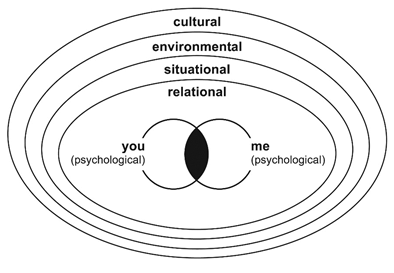
Think about the context in which you are writing. Thinking carefully about the context will assist you in deciding what content to include and what tone, style and structure to adopt.
Psychological: You, your personality, your experience, your values, beliefs, desires & needs.
Relational: How you relate to one another, define one another and behave in reaction to one another. With whom does the status and power lie? To what degree do you like / value / respect one another?
Situational: The social context or situation in which you and the reader(s) find yourselves, including the social conditions and conventions that apply to the particular situation.
Environmental: The physical factors governing the reading of the document: in what format is the communication written? Under what conditions is the reader likely to be reading it? Is the reader likely to be faced with pressures or distractions or is he/she likely to be able to read it at his/her leisure?
Cultural: The cultural norms, whether they be organisational, ethnic, or national, or any other learned behaviours that are expected within the culture in which one’s communication takes place. This includes company culture. Specifically, the established values and behaviours that contribute to the unique environment of any business. *
* Adapted from Improve Your Communication Skills by Alan Barker
Your reader
Put yourself in your reader’s shoes. How will your reader receive your piece of writing, considering his/her perspective?
Your content, tone, style and structure will be adapted for your specific reader(s) e.g. a report intended for the board and a press release intended to reach the general public would be two very different documents, not only because of their functions but also because of their readership.
Ask yourself:
For / to whom am I writing?
Who is going to read my document?
Is it confidential or is it intended for general distribution?
Does it have an even wider audience e.g. the general public?
What would my reader’s perspective be on receiving this piece of writing?
What does my reader need and/or want from this piece of writing?
Reader analysis
Ideally, you want to know as much about your readership as possible. However, sometimes some guesswork may be required.
Size:
Number of people / intended and potential reach of the document
Interests:
Common interests, needs and wants
Knowledge of the topic
Reasons for reading the document
Demographics:
Age
Gender
Educational background
Political affiliation
Religious beliefs
Cultural heritage
Expectations and Needs:
What does your reader (or each of your readers) expect /want to gain by reading your document?
The Message
What is your message?
What exactly do you want your readers to know?
How are you going to communicate the most important information to them as efficiently as possible?
What do you need your reader to understand for you to achieve your objective?
What specific language will you use to clarify your message and to serve your objective?
Tone
This is vital to consider before you send out any written communication, it is important to consider how your message will be received.
Ask yourself:
Is your tone appropriate to your readers and the context?
Is your tone appropriate to the type of document?
Does the tone support your intended objective?
What words would you use to describe your tone? (E.g. neutral, matter of fact, inspiring, courteous, polite, tactful, friendly, professional, etc.)
Is your tone harsh or aggressive? If so, how can you change it to achieve a more effective tone?
Note: In much the same way as when you are speaking, always be aware of your tone. If you write any message or document while you are angry or defensive – always take another look once you have calmed down or ask someone who is less emotionally invested to look over it for you. Never simply send a message written in anger.
Register – Formal or Informal?
Think about whether to write in a formal or informal register. This will depend on the purpose, audience and context of your written communication e.g. an annual report will be written in a formal style, whereas an email will usually be semi-formal. Even if your relationship to the reader is relaxed, in business emails, the register is not nearly as casual as the one you would use with your friends or family.
Differences in the formality of the register can be seen in:
- structure: the more structured the document, the more formal the document
- language and vocabulary: the more formal the language, the more formal the register
- pronouns:
- the use of the third person (he, she, they) can create a more removed, neutral impression and can increase formality
- the use of the second person (you) can create a more informal impression with a personal touch and can be useful for building relationships
- the use of the first person (I, we) is not always appropriate in certain types of business writing (e.g. reports); however, it can be used in emails, letters or proposals as to reflect agency and taking responsibility in more personalised correspondence
Style
Everyone has a style of writing, whether one is aware of it or not. It is influenced by many factors, some of which have been mentioned above. One is often unaware of what one’s style is, thinking that it is merely functional. But by being aware of one’s style and developing it further, one is essentially developing a unique writing signature.
An effective writing style in business communication is consistent, clear and easy to follow. For all written business communication:
- use complete sentences (aside from the occasional exception in emails, social media or for a specific purpose in motivational documents)
- keep your sentences and paragraphs short
- use simple, professional vocabulary
- use headings, sub-headings and bullet points to make your document more accessible to your reader, where necessary.
- it may only be appropriate to list attachments using bullet points
- keep to the point and provide adequate information – be brief, clear and specific
- avoid slang, jargon, elevated vocabulary and clichés
- edit and proofread your document carefully
Proofreading: Clarity and Accuracy
Ensure that your document contains no basic errors of spelling and grammar – have you used spell check? Have you done an extra check, applying your mind, over and above spell check?
Does your message read clearly?
Will all recipients know exactly what you are talking about?
Does the tone support your intended messages?
Confident Communicator Tip
It takes time and plenty of practice to develop your skills. So as you read through the advice in these notes and practise your writing skills, try to set realistic goals for yourself. Attempt to make some progress every day. Read good business journals, magazines, articles in newspapers, feature articles, and letters to the press. If you are searching for a suitable word, do not be afraid of using a dictionary and a thesaurus. Create links to online versions in your Favourites and refer to them often.